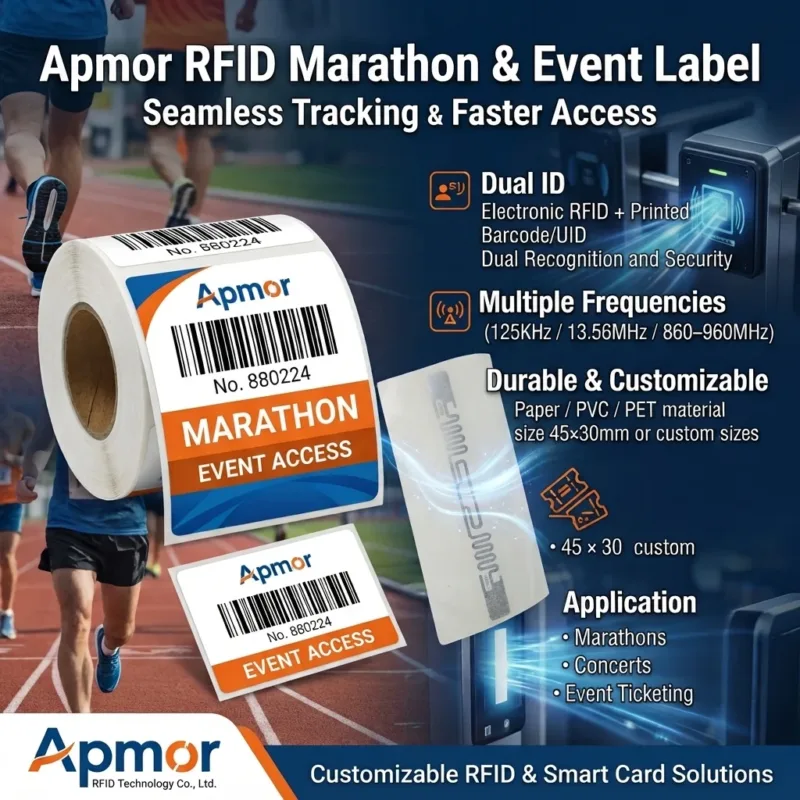
When event organizers need faster identification, manual bib checking can create queues, data-entry errors, and delays. An rfid barcode label combines electronic RFID identification with printed information, giving you a practical way to connect physical event materials with digital records. For marathon races, concerts, temporary activities, and other high-volume events, the right label should match your reader, frequency, material, and printing requirements. Apmor RFID Technology Co., Ltd. provides customizable RFID labels and smart card solutions, with its Marathon Label supporting multiple frequencies, chip options, and identification formats.
What Is an RFID Barcode Label?
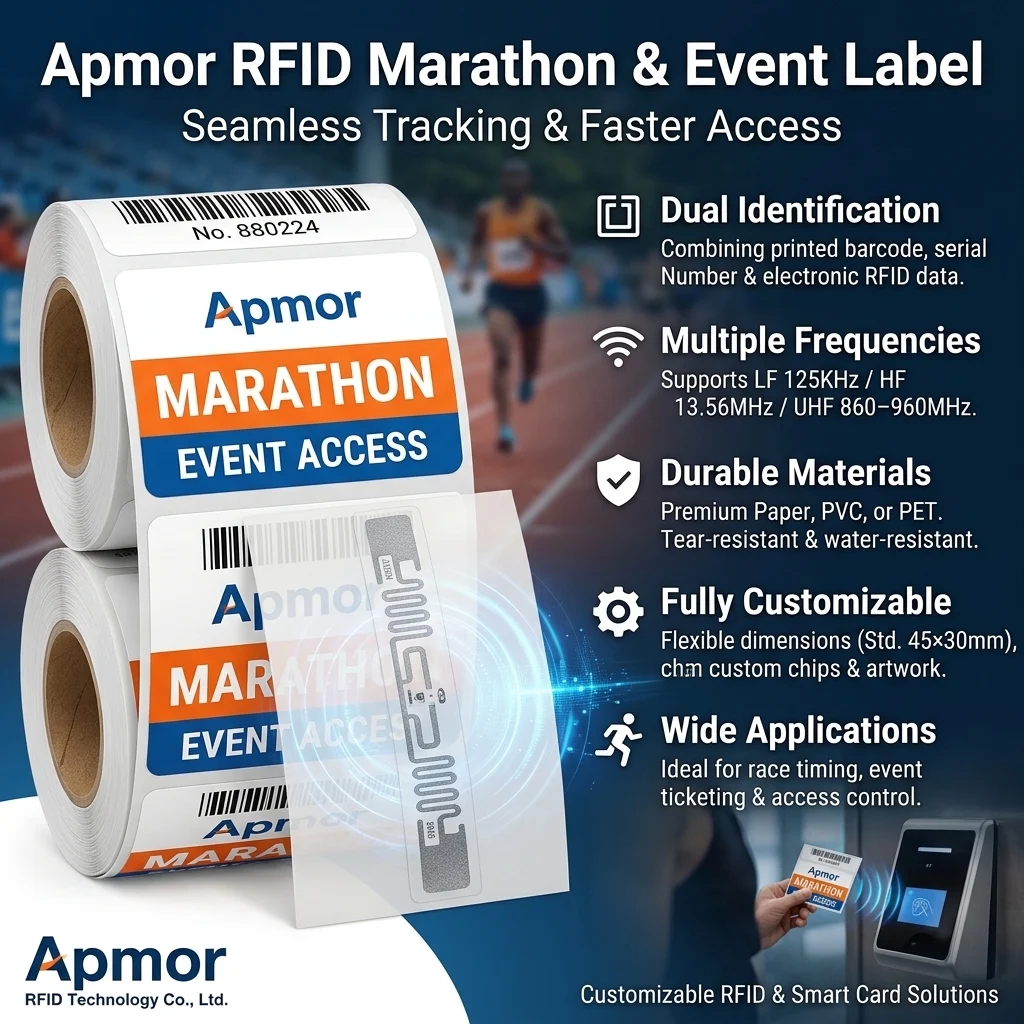
An RFID barcode label combines an RFID chip or inlay with printed identification such as a barcode, serial number, or UID number. This lets you use electronic identification while retaining a visible code that staff can scan or verify when needed.
For event applications, this combination can simplify participant identification, ticket management, race timing, and temporary access control. Apmor RFID’s Marathon Label is available in Paper, PVC, and PET, with a standard size of 45 × 30 mm or customized dimensions.
Key Specifications of the RFID Marathon Label
| Feature | Apmor RFID Marathon Label |
|---|---|
| Material | Paper / PVC / PET |
| Size | 45 × 30 mm / Customized |
| Frequency | 125KHz / 13.56MHz / 860–960MHz |
| Available Chips | FM11RF08, TK4100, EM4100, EM4200, EM4305, T5577 and others |
| Data Retention | Up to 10 years |
| Programming Cycles | ≥100,000 |
| Memory | 144 byte, 128 byte, 1KB and others |
| Reading Range | 0–5 m, depending on reader and antenna |
| Identification | Barcode, serial number, UID number |
| Application | Event ticketing, concerts, temporary activities |
The available frequency range gives you flexibility when matching the label with your existing RFID infrastructure. However, you should confirm chip and reader compatibility before bulk production because reading performance depends on the selected configuration, reader, antenna, and installation environment.
How to Use an RFID Barcode Label for Event Tracking
A practical RFID event tracking workflow can follow these steps:
- Define the event requirement
Determine whether you need the label for marathon timing, ticketing, participant identification, access control, or another event process. - Choose the RFID frequency
Match 125KHz, 13.56MHz, or 860–960MHz with your existing reader and antenna system. - Select the chip and memory
Choose the chip according to your required data capacity, programming cycles, and communication system. - Set the label format
Specify the size, material, barcode, serial number, UID, artwork, and other printing requirements. - Test the sample
Check reading distance, encoding performance, printing quality, and compatibility with your actual equipment. - Confirm mass production
After sample verification, finalize the quantity, specifications, packaging, and delivery requirements.
This approach helps you avoid a common purchasing problem: selecting an RFID label based only on appearance or price without checking system compatibility.
RFID Barcode Label vs. Traditional Printed Label
A traditional printed label can display participant or ticket information, but it does not provide electronic identification by itself. An RFID barcode label gives you both visible identification and RFID-based data access.
| Comparison | RFID Barcode Label | Traditional Printed Label |
|---|---|---|
| Electronic identification | Yes | No |
| Barcode printing | Yes | Yes |
| UID / serial number | Available | Printed only |
| Automated reading | RFID reader | Manual or barcode scanner |
| Data retention | Up to 10 years, depending on chip | Not applicable |
| Programming | ≥100,000 cycles, depending on chip | Not applicable |
| Custom size | Available | Usually available |
| Event applications | Timing, ticketing, tracking | Ticketing and visual identification |
For a marathon, for example, RFID technology can help connect a participant’s unique identifier with timing or registration data. The visible barcode or serial number can then provide an additional reference for staff when needed.
Why Choose Apmor RFID for Custom RFID Labels?
Apmor RFID Technology Co., Ltd. was founded on October 24, 2022, in Shenzhen and focuses on RFID labels and smart card solutions. The company describes itself as a high-tech manufacturer and states that its products undergo multiple testing processes to support stability and reliability.
For project buyers, Apmor RFID provides:
- Multiple RFID frequencies: 125KHz, 13.56MHz, and 860–960MHz options for different systems.
- Flexible materials: Paper, PVC, and PET configurations.
- Custom dimensions: Suitable when your event format requires a specific label size.
- Identification printing: Barcode, serial number, and UID options.
- Technical support: Assistance with product selection and RFID requirements.
- Customization services: Different sizes, chip types, and printing configurations can be discussed for specific projects.
Apmor also serves applications beyond event labels, including RFID wristbands, on-metal tags, laundry tags, keyfobs, windshield tags, inlays, and smart cards. This broader product range can be useful when you need multiple RFID formats for one project.
Common Applications of RFID Barcode Labels
Marathon and Race Timing
For marathon organizers, an RFID label can associate a unique participant identifier with race management data. The combination of RFID and printed identification also gives staff a physical reference during registration and event operations.
Concerts and Temporary Events
You can use RFID labels for electronic ticketing, participant identification, or temporary access management. Custom printing allows event organizers to add visible numbers, barcodes, or other event information.
Asset and Inventory Identification
With the appropriate RFID frequency and reader system, RFID labels can also connect physical items with digital records. This approach can reduce manual data entry during identification and tracking workflows.
FAQ
1. What frequency does an RFID barcode label use?
The Apmor RFID Marathon Label supports 125KHz, 13.56MHz, and 860–960MHz options. You should select the frequency according to your RFID reader, antenna, and application.
2. Can I customize an RFID barcode label?
Yes. Apmor RFID offers customized sizes and supports barcode, serial number, and UID identification. You can also specify the required material and chip configuration.
3. What should I check before ordering RFID labels?
Check the frequency, chip model, memory, reading range, material, label size, printing requirements, and reader compatibility. Testing samples with your actual equipment before mass production is recommended.
Conclusion
Choosing the right rfid barcode label can help you connect visible identification with electronic RFID data in marathon timing, event ticketing, concerts, and temporary activities. Apmor RFID’s Marathon Label supports Paper, PVC, and PET materials, 125KHz/13.56MHz/860–960MHz frequencies, 45 × 30 mm or customized sizes, up to 10 years of data retention, and ≥100,000 programming cycles, giving you several configuration options for different event requirements. If you need a customized RFID label, evaluate the chip, frequency, reader compatibility, material, and printing requirements before placing your order.


Add comment