
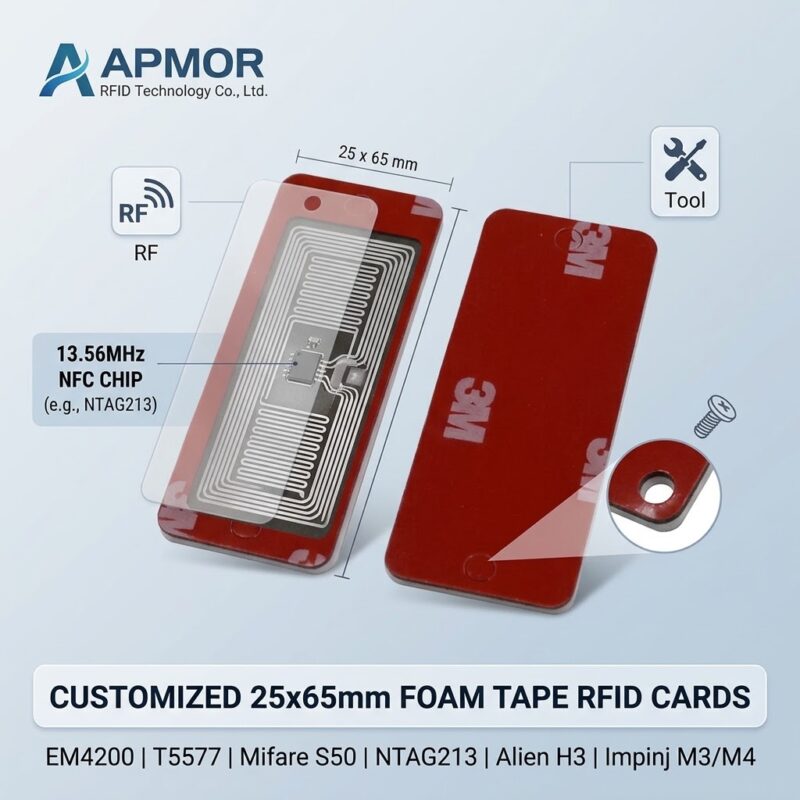
Choosing the right rfid card chip is essential when you need a reliable identification card that fits a specific installation environment. However, standard PVC cards may not provide the mounting flexibility required for equipment identification, access management, or compact tracking applications. You may also need a particular frequency, memory capacity, or chip protocol to ensure compatibility with your existing RFID reader.
Apmor RFID Technology Co., Ltd. offers a customized 25×65 mm foam tape card designed to address these requirements. Featuring a PVC body, side holes, and adhesive foam backing, this card combines RFID functionality with a practical attachment structure. With several chip options and frequency configurations available, you can select a solution that matches your application and technical requirements.
Understanding RFID Card Chip Options
An RFID card chip stores identification data and communicates with a compatible reader through radio frequency signals. The chip you select determines important characteristics, including operating frequency, memory capacity, communication compatibility, and reading performance.
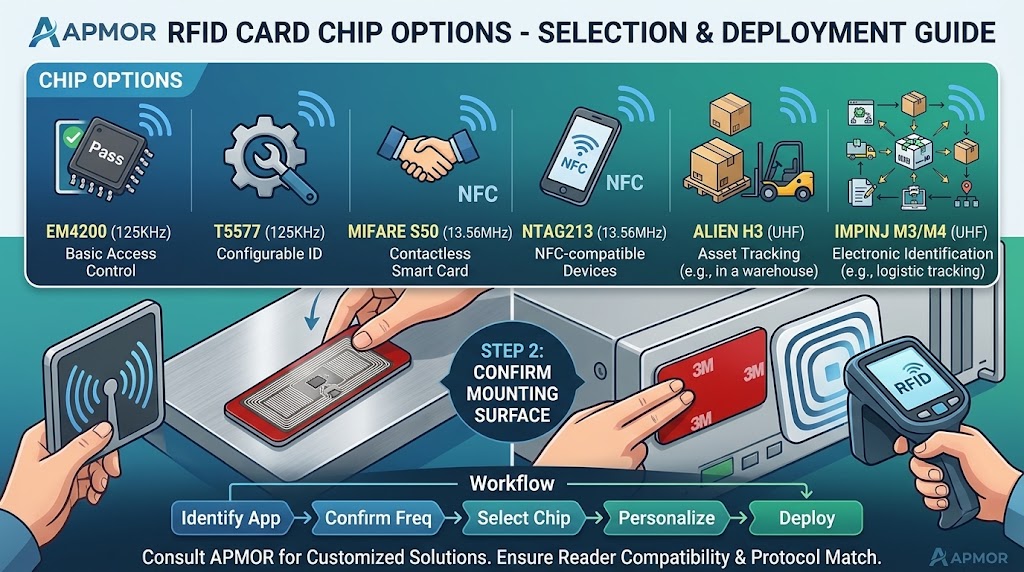
The customized 25×65 mm foam tape card supports several chip options:
- EM4200: A low-frequency RFID chip commonly used for identification and access applications.
- T5577: A configurable 125KHz chip suitable for compatible identification systems.
- Mifare S50: A 13.56MHz contactless chip used in access control, loyalty programs, and other smart card applications.
- NTAG213: A 13.56MHz NFC-compatible chip suitable for applications involving compatible NFC devices.
- Alien H3: A UHF RFID chip designed for identification and inventory-related applications.
- Impinj M3/M4: UHF RFID chip options for applications requiring electronic identification and data collection.
These options cover different RFID operating environments. Before selecting a chip, check your reader’s frequency, protocol, and supported chip specifications.
Technical Specifications of the 25×65 mm RFID Foam Tape Card
The product combines a compact card structure with adhesive mounting features. Its PVC construction provides a practical base for customized RFID applications, while the foam tape helps you attach it to suitable surfaces.
| Specification | Product Details |
|---|---|
| Product type | Customized RFID card |
| Material | PVC |
| Standard size | 25×65 mm |
| Customization | Custom sizes available |
| Chip options | EM4200, T5577, Mifare S50, NTAG213, Alien H3, Impinj M3/M4 |
| Operating frequency | 125KHz / 13.56MHz / 860–960MHz |
| Data retention | 10 years |
| Programming cycles | ≥100,000 |
| Memory options | 128 bytes, 144 bytes, 1K byte, etc. |
| Reading range | 0–5 m, depending on reader and antenna |
| Available crafts | Hot stamping, thermal printing, magnetic stripe, barcode, serial number, UID |
The listed specifications provide a starting point for product selection. Actual memory capacity, reading distance, and programming performance depend on the selected chip configuration and compatible equipment.
Why Choose a Foam Tape RFID Card?
Unlike conventional RFID cards designed primarily for hand-held use, this model includes features that support fixed installation.
- Adhesive foam backing: Helps attach the card to compatible flat surfaces without relying exclusively on a separate card holder.
- Side holes: Provide additional mounting or fastening options when your installation requires mechanical attachment.
- Compact dimensions: The 25×65 mm format fits applications where a smaller identification component is more practical than a standard-sized card.
- Customizable appearance: Printing and finishing options help you incorporate identification numbers, barcodes, or other visual information.
For installation, check the surface material, cleanliness, temperature, and expected operating conditions to determine whether the adhesive backing is suitable.
Comparing RFID Frequencies and Chip Applications
Different RFID frequencies serve different operational purposes. Understanding these differences helps you avoid purchasing a card that cannot communicate with your existing system.
| Frequency | Chip Examples | Typical Applications |
|---|---|---|
| 125KHz | EM4200, T5577 | Basic identification and compatible access systems |
| 13.56MHz | Mifare S50, NTAG213 | Contactless cards, loyalty programs, NFC applications |
| 860–960MHz | Alien H3, Impinj M3/M4 | Inventory identification, logistics, asset tracking |
For example, if you need a card for a 13.56MHz contactless system, you should consider Mifare S50 or NTAG213 rather than selecting a 125KHz chip.
Similarly, UHF applications require compatible readers and antennas operating within the appropriate regional frequency range. Although the product lists a reading range of up to 5 meters, actual performance varies with the reader, antenna, installation environment, and selected chip.
Where Can You Use a Customized RFID Foam Tape Card?
The product specification identifies public transportation, loyalty cards, event ticketing, and car parking as potential application areas. Its adhesive backing and side holes also make it worth considering for specific fixed-installation requirements.
Potential applications include:
- Equipment identification: Attach RFID identification cards to suitable equipment or designated mounting surfaces.
- Access management: Integrate compatible RFID chips into identification systems that support the selected frequency and protocol.
- Parking management: Use compatible RFID configurations for vehicle or parking-related identification.
- Event management: Support identification and ticketing workflows where the selected chip meets system requirements.
- Loyalty programs: Configure suitable contactless chips for compatible customer identification systems.
Before deployment, verify reader compatibility, installation requirements, and the data-handling capabilities of your RFID system.
How to Select and Customize Your RFID Card
Selecting a suitable RFID card involves more than choosing a chip. You should consider the complete installation and communication requirements.
Follow these steps when preparing your order:
- Identify your application: Determine whether you need access identification, equipment tracking, parking management, or another RFID application.
- Confirm the frequency: Check whether your existing reader operates at 125KHz, 13.56MHz, or 860–960MHz.
- Select the chip: Choose from the available EM4200, T5577, Mifare S50, NTAG213, Alien H3, or Impinj M3/M4 options according to system compatibility.
- Confirm the card dimensions: Use the standard 25×65 mm format or discuss customized dimensions with the supplier.
- Specify the mounting requirements: Confirm whether you need adhesive foam backing, side holes, or both.
- Finalize personalization: Discuss hot stamping, thermal printing, barcode numbers, serial numbers, and UID identification requirements.
You should also confirm memory configuration, encoding requirements, sample testing, and applicable product compliance documentation before placing a bulk order.
FAQ
1: What RFID chips are available for the 25×65 mm foam tape card?
Available options include EM4200, T5577, Mifare S50, NTAG213, Alien H3, and Impinj M3/M4. Each chip supports different operating frequencies and applications, so select one that matches your RFID reader.
2: Can I customize the size and printing of the RFID foam tape card?
Yes. The standard size is 25×65 mm, and customized dimensions are available. You can also discuss printing and finishing options, including hot stamping, thermal printing, barcodes, serial numbers, and UID numbers.
3: What is the maximum reading distance of this RFID card?
The listed reading range is 0–5 meters. However, this is not a guaranteed distance for every configuration. Actual performance depends on the selected chip, reader, antenna, and surrounding environment.
Conclusion
Selecting the right rfid card chip helps ensure that your customized RFID card works with your existing identification or tracking system. Apmor’s 25×65 mm foam tape card combines multiple chip options, PVC construction, side holes, and adhesive backing to support different installation and identification requirements. By confirming the frequency, chip compatibility, dimensions, and mounting conditions before ordering, you can choose a configuration that meets your operational needs.
Request a Customized RFID Card from Apmor
Looking for a compact RFID card with adhesive backing and flexible chip configurations? Apmor RFID Technology Co., Ltd. specializes in RFID labels and smart card solutions, offering customization options for different industry requirements.
Contact the Apmor team to discuss your project specifications, including:
- Required RFID frequency and chip model
- Card dimensions and material
- Foam tape and side-hole configuration
- Printing, encoding, and personalization
- Sample requirements and bulk orders
Visit Apmor RFID to explore its RFID product range and request a customized solution.


Add comment