
A custom RFID label helps you identify products, track assets, and manage information without relying entirely on manual data entry. However, choosing the wrong label material, chip, or frequency can create compatibility problems, shorten service life, and increase operating costs. Your RFID label must match your application, reader system, and environmental conditions.
Apmor RFID Technology Co., Ltd. develops RFID labels and smart cards for businesses seeking customized identification solutions. Its PET Label uses PET material and 13.56MHz high-frequency (HF) technology, with options for different chips, dimensions, and printing methods. These features make it worth evaluating for library management, logistics, asset management, and electronic ticketing applications.
Before selecting a supplier, you should understand the technical specifications, customization options, and limitations of each label type. This guide explains how to evaluate a custom PET RFID label for your project.
What Is a Custom RFID Label?
A custom RFID label is an identification label designed around your requirements for material, dimensions, RFID chip, data storage, printing, and application. Unlike a conventional printed sticker, an RFID label contains an electronic component that communicates with a compatible RFID reader.
Apmor RFID’s PET Label is specified as an HF RFID product operating at 13.56MHz. Its available chip options include NXP S50, NXP S70, F08, ICODE SLi series, NTAG213, NTAG215, and NTAG216, depending on the selected configuration.
The product listing provides the following specifications:
| Specification | Product details |
|---|---|
| Label material | PET |
| Operating frequency | 13.56MHz HF |
| Listed size | 35 × 25mm; customization available |
| Available chips | NXP S50, NXP S70, F08, ICODE SLi series, NTAG213, NTAG215, NTAG216 |
| Data retention | 10 years, as specified in the product listing |
| Programming cycles | ≥100,000, as specified in the product listing |
| Reading range | 0–10cm, depending on the reader and antenna |
| Memory options | 128 bytes, 144 bytes, 1KB, depending on the chip |
| Printing options | Offset, screen, digital, and inkjet printing |
| Additional options | Barcode, serial number, and UID number |
These specifications provide a starting point for product selection. Actual performance depends on the chip, antenna design, reader, installation environment, and configuration.
Why Choose a Custom PET RFID Label?
1. Adapt the label to your product
A standard label may not fit your product dimensions or identification workflow. With a custom RFID label, you can discuss label size, printed information, and chip selection before production.
Apmor RFID lists 35 × 25mm as a standard size for this PET Label and also indicates that customized dimensions are available. This gives you a reference point when planning labels for packages, files, equipment, or other assets.
2. Combine RFID identification with printed information
RFID technology supports electronic identification, while printed information helps employees recognize items visually. Depending on your requirements, you can request printing methods such as offset, screen, digital, or inkjet printing, along with barcode and serial-number information.
For example, a logistics team could use a printed serial number for visual checks and an RFID chip for electronic identification. Before ordering, confirm whether your preferred chip, encoding format, and printing layout are supported together.
3. Select a chip that matches your system
Not all RFID chips provide the same memory capacity or functions. NTAG213, NTAG215, NTAG216, and ICODE SLi-series chips serve different technical requirements, so you should select a model based on your reader compatibility and data needs.
The listed memory options range from 128 bytes to 1KB. These figures should not be treated as interchangeable specifications for every chip; ask the supplier to confirm the exact usable memory and supported commands for your selected model.
Where Can You Use Custom RFID Labels?
A custom PET RFID label can support several identification workflows, provided the selected chip and label design suit the application.
- Library management: Identify books, manage item records, and support compatible RFID-based circulation workflows.
- Logistics: Associate tagged items with electronic records and improve identification during inventory checks.
- Asset management: Label equipment and maintain links between physical assets and digital records.
- Electronic ticketing: Support ticket identification where the chip, reader, and access-control system are compatible.
For example, a library evaluating these labels should first test the selected chip with its existing HF readers. A logistics company should also consider reading distance, tag placement, and whether metal or liquid near the label affects performance.
The listed 0–10cm reading range is a product reference, not a guaranteed distance in every installation.
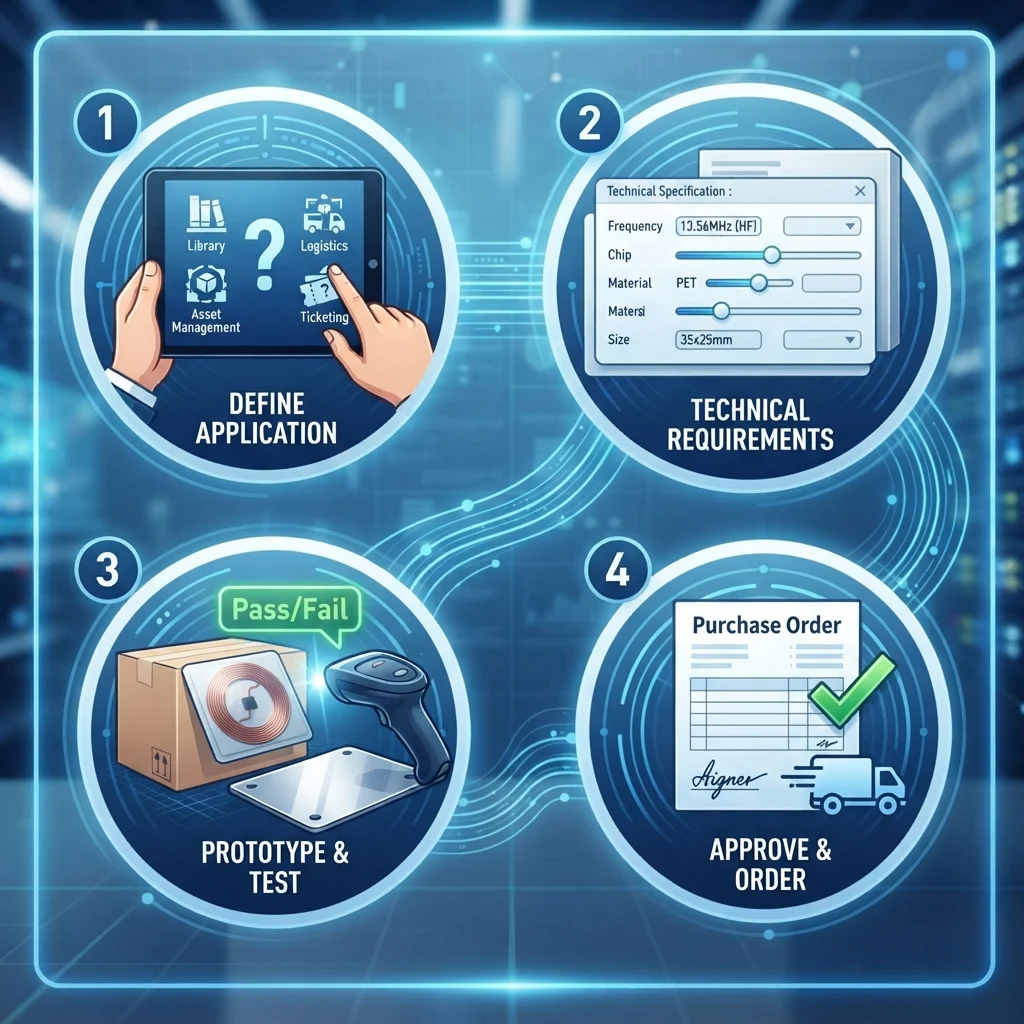
How to Order the Right Custom RFID Label
Follow these steps to reduce compatibility issues before placing a bulk order.
- Define your application. Identify whether you need the label for library circulation, logistics, asset tracking, or electronic ticketing.
- Confirm reader compatibility. Check that your existing reader supports 13.56MHz HF technology and the selected chip protocol.
- Choose the material and size. Start with PET and the listed 35 × 25mm format, then confirm whether another dimension or adhesive construction is required.
- Specify chip and memory requirements. Tell the supplier what information you need to store and which chip models your system supports.
- Finalize the printing design. Provide artwork, barcode requirements, serial-number formats, or UID-related requirements for technical review.
- Request samples and testing. Test read performance, encoding, adhesion, and compatibility under actual operating conditions before approving mass production.
Apmor RFID was established on October 24, 2022, and focuses on RFID labels and smart cards. Its stated service offering includes customized products, technical support, supply chain management, and after-sales support. Request written confirmation of production specifications, quality-control procedures, and any certifications required for your project.
Custom RFID Label vs. Conventional Printed Label
| Feature | Custom RFID label | Conventional printed label |
|---|---|---|
| Electronic identification | Available with a compatible RFID chip | Not available unless combined with electronic components |
| Reading method | Compatible RFID reader | Visual inspection or optical scanning |
| Printed information | Can combine printing and RFID identification | Supports printed text, graphics, and barcodes |
| System requirements | Requires compatible RFID hardware and software | Depends on the chosen identification method |
| Best-fit applications | Electronic identification and RFID-based workflows | Basic labeling and visual identification |
The right choice depends on your workflow. If you only need visible product information, a conventional label may be sufficient. If you need electronic identification, a custom RFID label may offer additional functionality, provided your infrastructure supports it.
Frequently Asked Questions
1. What frequency does Apmor RFID’s PET Label use?
The listed PET Label operates at 13.56MHz HF. Confirm the selected chip and protocol with Apmor RFID before integrating it with your reader system.
2. Can I customize the size and printing?
The product listing specifies a 35 × 25mm size and indicates that customization is available. Listed printing options include offset, screen, digital, and inkjet printing. Confirm minimum order quantities, adhesive options, artwork requirements, and production lead times directly with the supplier.
3. How far away can a custom RFID label be read?
The listed reading range is 0–10cm, depending on the reader and antenna. Actual results can vary with tag orientation, reader power, antenna design, surrounding materials, and installation conditions. Test samples with your intended hardware before finalizing the design.
Conclusion
Choosing the right custom rfid label requires more than selecting a material or printed design. You need to match the RFID frequency, chip, memory, dimensions, and reader compatibility to your specific workflow. Apmor RFID’s PET Label offers a 13.56MHz HF configuration, multiple listed chip options, customizable dimensions, and several printing methods for applications such as library management, logistics, asset management, and electronic ticketing.
Evaluate your technical requirements first, then validate the proposed configuration through sample testing. This approach helps you select a label that fits your identification process and reduces avoidable integration issues.
Contact Apmor RFID to discuss your custom RFID label requirements. Share your application, target dimensions, preferred chip, reader model, and printing specifications to request a suitable configuration and sample evaluation.




Add comment