When inventory moves between storage, production, and transportation, manual identification can create delays, misplaced materials, and inaccurate records. RFID tags for inventory give you a practical way to identify and track materials without relying entirely on manual scanning. With RFID technology, you can connect physical items to digital records and improve visibility across your operations.
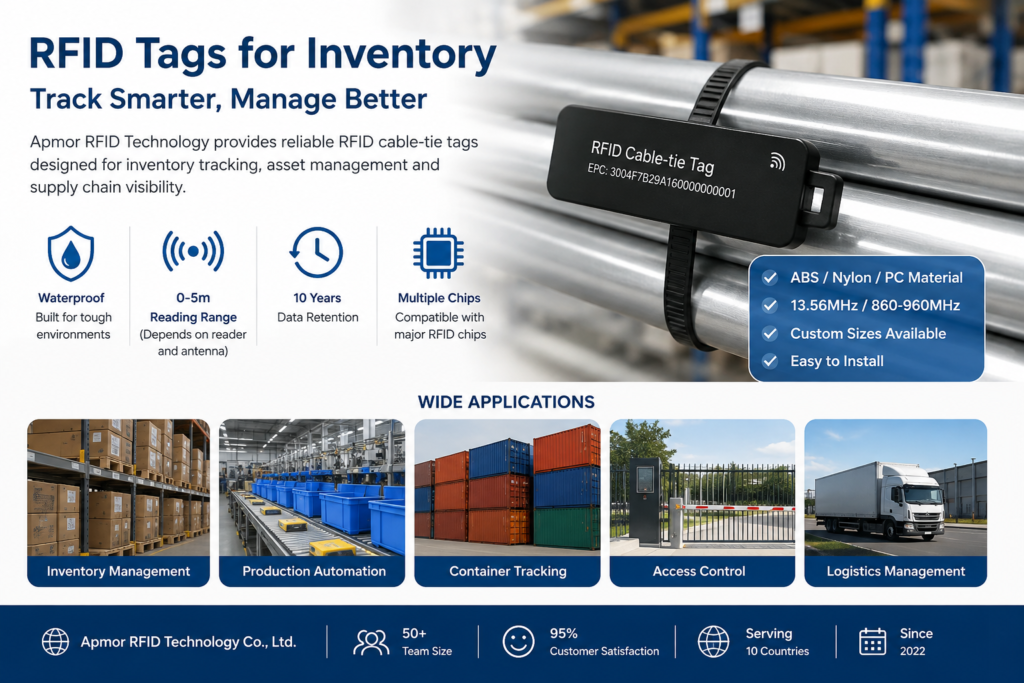
For applications that require durable attachment, Apmor RFID Technology provides RFID Cable-tie Tags designed for logistics management, production automation, container tracking, and access control. The tags support multiple RFID chips, materials, frequencies, and customized sizes, allowing you to select a configuration according to your operating environment.
Why Use RFID Tags for Inventory Management?
Traditional labels and manual identification can become difficult to manage when materials move frequently. An RFID system allows you to identify tagged items using compatible RFID readers and antennas, reducing the need for direct visual identification.
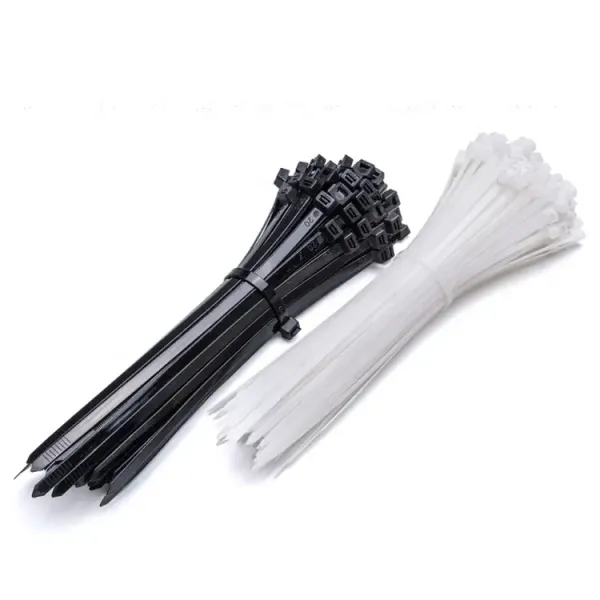
Apmor’s RFID Cable-tie Tag is particularly suitable when you need to attach an RFID tag securely around a material, component, container, or other physical asset.
Key product specifications include:
- Materials: ABS, Nylon, and PC
- Frequencies: 13.56 MHz and 860–960 MHz
- Reading range: 0–5 m, depending on the reader and antenna
- Data retention: 10 years
- Programming cycles: ≥100,000
- Available sizes: 200 mm, 330 mm, 345 mm, 445 mm, and customized sizes
- Product features: Waterproof design and UID number options
- Memory options: 144 bytes, 1 KB, 128 bytes, and others
These specifications make the product suitable for businesses that need durable identification and repeatable RFID data management.
RFID Tags for Inventory: Choosing the Right Configuration
Not every inventory environment requires the same RFID technology. Your choice should depend on reading distance, operating frequency, attachment method, material, and the RFID reader already used in your facility.
| Requirement | RFID Cable-tie Tag Option | Suitable Application |
|---|---|---|
| Short-range identification | 13.56 MHz | Access control, item identification |
| Longer-range tracking | 860–960 MHz UHF | Inventory and logistics |
| Secure physical attachment | Cable-tie structure | Materials and containers |
| Outdoor or demanding environments | Waterproof construction | Logistics and asset tracking |
| Repeated programming | ≥100,000 cycles | Automated operations |
| Special installation requirements | Customized size | Non-standard materials |
For inventory tracking over greater distances, the UHF RFID tag configuration can be considered because the product supports 860–960 MHz and a stated reading range of up to 5 m, depending on the complete reader and antenna setup.
How to Implement RFID Inventory Tracking
You can introduce RFID tags for inventory through a structured process rather than replacing your entire workflow at once.
1. Identify the materials to track
Determine which products, containers, components, or assets create the most inventory-management challenges. Prioritize high-value, frequently moved, or difficult-to-identify items.
2. Select the RFID frequency
Choose between 13.56 MHz and 860–960 MHz according to your reader infrastructure and required reading distance. For longer-range inventory and logistics applications, evaluate the UHF option with your actual reader and antenna.
3. Select the attachment method
The cable-tie format provides a practical attachment method for materials that cannot use conventional adhesive labels. You can also request customized dimensions for specific installation requirements.
4. Program and test the tags
Before large-scale deployment, test reading distance, tag orientation, material interference, and reader performance. Apmor’s listed product supports ≥100,000 programming cycles and offers multiple chip options, including Alien H3/H4 and Impinj M4/M5.
5. Connect RFID data with your workflow
Use the RFID reader data within your inventory, logistics, production, or asset-management process. This allows you to associate each UID or programmed tag with the corresponding physical item.
Real-World Applications of RFID Inventory Tags
The product is designed for several practical business scenarios.
Logistics management: Attach RFID cable-tie tags to goods, containers, or transport materials to improve item identification during movement.
Production automation: RFID identification can help associate components with production processes and support automated material management.
Container tracking: The cable-tie structure provides a convenient attachment method for containers and reusable transport assets.
Access control: Compatible 13.56 MHz configurations can support identification applications when matched with an appropriate RFID system.
For each application, you should validate the tag, reader, antenna, mounting position, and surrounding materials before deployment.
Why Choose Apmor RFID Technology?
Founded on October 24, 2022, Apmor RFID Technology Co., Ltd. specializes in RFID labels and smart cards. The company reports a team of more than 50 people, 95% customer satisfaction, and service coverage across 10 countries.
Apmor offers customization across RFID products, including material selection, chip configuration, dimensions, and product design. Its stated service scope also includes technical support, global supply chain management, and after-sales service.
For E-E-A-T and procurement verification, you should review the company’s actual certification documents, test reports, chip specifications, and samples before placing a large-volume order. This approach lets you verify product suitability based on documented evidence rather than relying only on marketing claims.
FAQ
What are RFID tags for inventory?
RFID tags for inventory are electronic identification tags that store or transmit product-related information to compatible RFID readers. They can help businesses identify and track materials, products, containers, and other assets.
Are RFID cable-tie tags suitable for inventory tracking?
Yes. Their physical attachment method makes them useful for materials, containers, logistics assets, and other items where adhesive labels may be inconvenient. The Apmor RFID Cable-tie Tag also supports customized sizes and waterproof construction.
What is the reading range of the Apmor RFID Cable-tie Tag?
The listed reading range is 0–5 m, depending on the RFID reader and antenna. Actual performance can vary based on frequency, tag orientation, mounting material, reader power, antenna design, and the surrounding environment.
Conclusion
If you need rfid tags for inventory that can attach securely to materials while supporting logistics, production, and asset-tracking workflows, RFID Cable-tie Tags offer a practical option. Apmor RFID Technology provides multiple chip choices, 13.56 MHz and 860–960 MHz frequencies, customized sizes, waterproof construction, and up to 10 years of stated data retention. Before deployment, test the selected configuration with your actual reader, antenna, materials, and operating environment to confirm performance.
CAT
Contact Apmor RFID Technology to discuss your inventory application, required tag size, RFID frequency, chip type, and quantity. Request product samples and technical specifications before moving to bulk production.


Add comment