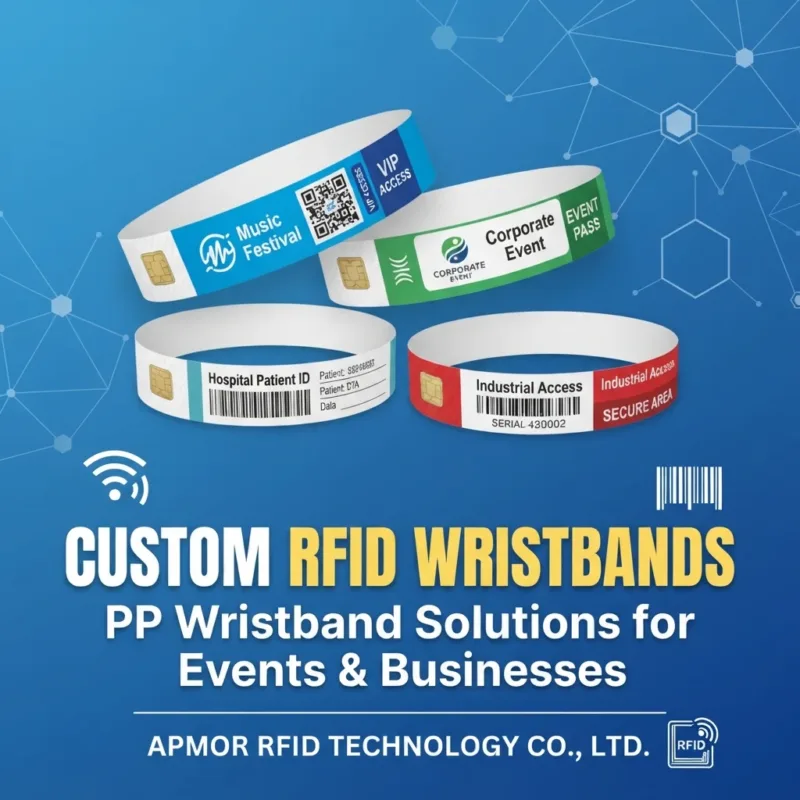
If you need rfid wristbands custom for events, visitor management, or identification, choosing the right material and chip technology can affect your operating costs and user experience. Standard wristbands may not offer the printing options, identification capabilities, or environmental resistance your application requires. A well-specified wristband helps you identify users, organize access, and support efficient workflows.
Apmor RFID Technology Co., Ltd. manufactures RFID labels and smart cards and offers customized RFID solutions for different industries. Its PP Wristband combines a synthetic paper material with optional RFID chips and personalized printing, making it a practical option for businesses that need disposable identification products. Before placing a bulk order, you should evaluate chip compatibility, reading distance, printing requirements, and the conditions in which people will wear the wristbands.
What Are Custom RFID Wristbands?
Custom RFID wristbands are wearable identification products that combine a wristband with an RFID inlay or chip. Depending on the configuration, a compatible reader can identify the wristband without requiring direct visual contact with a printed number or barcode.
For event organizers and business buyers, customization can include:
- Material: PP synthetic paper for lightweight, disposable wristbands.
- Chip selection: Compatible 13.56 MHz options, depending on the required system.
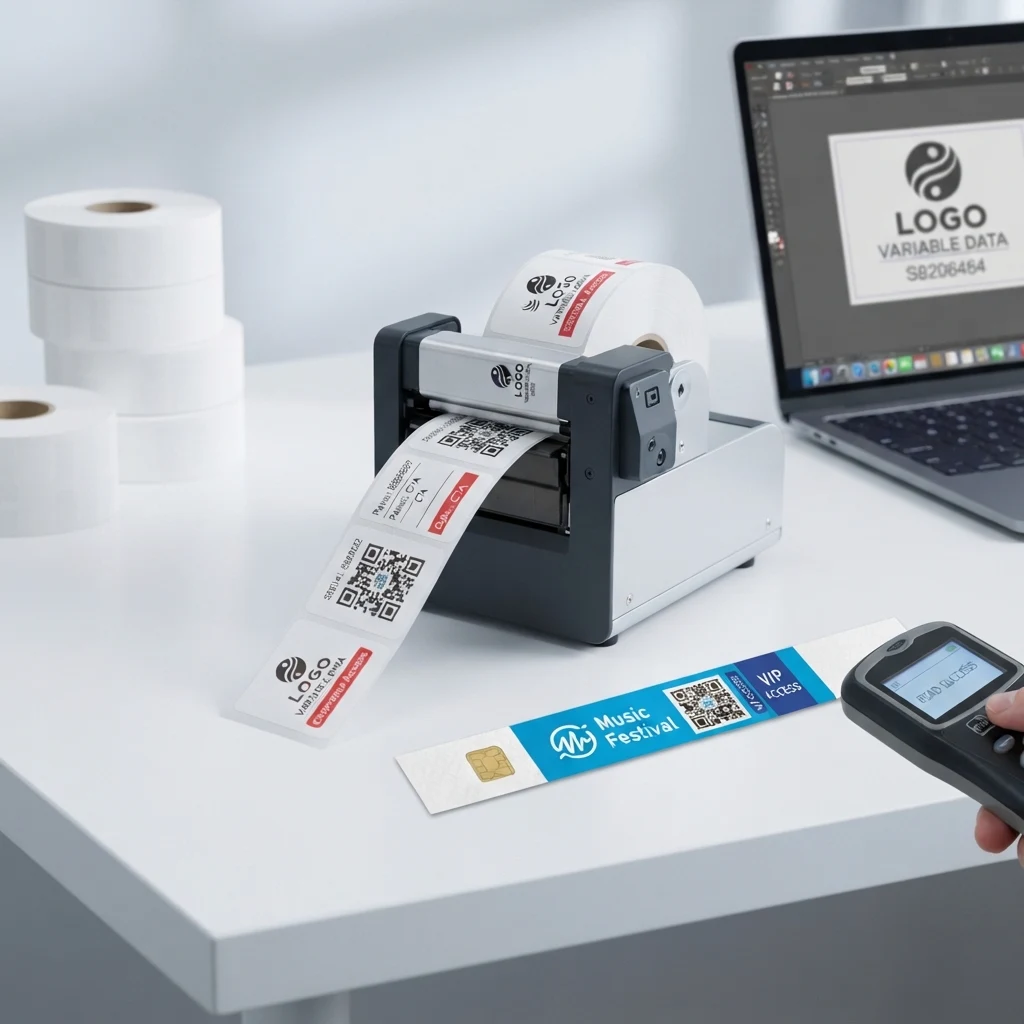
- Printing: Logos, serial numbers, URLs, barcodes, and QR codes.
- Dimensions: The listed PP Wristband measures 250 × 25 mm.
- Application-specific design: Adapt the wristband to your identification, access management, or tracking workflow.
When sourcing custom RFID wristbands, confirm that the chip protocol matches your existing readers and software. A printed QR code or barcode provides a separate identification method; it does not automatically function as an RFID interface.
PP RFID Wristband Specifications
Apmor RFID lists the PP Wristband as a single-use product made from PP synthetic paper. Buyers can consider this design for events, visitor identification, and selected operational environments where disposable wristbands are appropriate.
| Specification | Product details |
|---|---|
| Product type | PP synthetic paper wristband |
| Material | PP synthetic paper |
| Dimensions | 250 × 25 mm |
| Frequency options | 13.56 MHz |
| Listed chip options | S50, S70, F08, Ultralight, ICODE SLI series |
| Printing options | Logo, serial number, URL, barcode, QR code |
| Listed operating temperature | -20°C to 70°C |
| Published read range | Varies by chip, protocol, tag size, and reader |
| Intended use | Single-use identification and selected RFID applications |
The product information lists reading distances of 2–5 cm for ISO 14443A and 2–8 cm for ISO 15693, while another specification gives a general range of 1–10 cm. These figures should be treated as configuration-dependent reference values rather than guaranteed performance. Ask Apmor RFID to confirm the expected reading distance for your selected chip and reader.
The listed chip families also support different protocols and functions. Therefore, verify the exact chip model, memory requirements, reader compatibility, and data-handling needs before production.
Where Can You Use Custom PP RFID Wristbands?
1. Events, Festivals, and Parks
Event organizers can use custom printed RFID wristbands to associate visitors with tickets, registration records, or access permissions when the wristbands are integrated with a compatible system. Logos and unique identifiers can also help staff distinguish visitor groups.
For festivals and parks, confirm whether you need disposable admission identification, cashless payment integration, or another function. Payment functionality requires compatible infrastructure and software; a wristband alone does not provide a complete cashless system.
2. Hospitals and Mother-and-Baby Care
Healthcare facilities can use wristbands to support patient identification and authorized workflow checks. In mother-and-baby care, unique identifiers can help staff associate records with the correct patient when used within an appropriately configured hospital system.
However, medical use requires more than RFID compatibility. Before ordering, verify skin-contact suitability, hygiene procedures, applicable regulatory requirements, and compatibility with the hospital’s identification system.
3. Industrial and Humid Environments
Businesses may also evaluate RFID wristbands for selected fieldwork, controlled-access areas, and other operational settings. Although the product lists an operating temperature range of -20°C to 70°C, temperature tolerance alone does not establish waterproof performance, chemical resistance, or suitability for every industrial environment.
PP RFID Wristbands vs. Other Wristband Materials
Different materials serve different purchasing needs. Compare the main characteristics before selecting a custom wristband.
| Feature | PP synthetic paper | Silicone | Fabric |
|---|---|---|---|
| Typical use | Disposable identification | Reusable identification | Events and longer-wear applications |
| Printing and branding | Logo and variable data options | Depends on manufacturing method | Depends on fabric and printing method |
| Reuse potential | Intended for single use | Generally reusable | Depends on construction |
| RFID integration | Available with compatible chip configuration | Available with compatible chip configuration | Available with compatible chip configuration |
| Main consideration | Disposal and application requirements | Comfort and durability | Wear time and construction |
If you need disposable wristbands for a large event, PP synthetic paper may be worth evaluating. If visitors need to wear wristbands repeatedly, compare reusable materials and their lifecycle costs instead.
How to Order Custom RFID Wristbands from Apmor RFID
Follow these steps to prepare a more accurate quotation and reduce compatibility issues.
- Define your application. Specify whether you need event admission, visitor identification, hospital identification, or another use case.
- Confirm the RFID system. Provide the required frequency, protocol, chip model, reader type, and software requirements.
- Choose the customization. Submit your logo, artwork, numbering format, QR code, barcode, and preferred dimensions.
- Request a sample or technical confirmation. Check print quality, fastening method, readability, and wearing conditions before approving mass production.
- Confirm the commercial terms. Ask about minimum order quantity, unit pricing, lead time, packaging, shipping, and quality inspection arrangements.
Apmor RFID Technology Co., Ltd. was established in 2022 and focuses on RFID tags and smart cards. When discussing a custom order, request the relevant product specifications and quality documentation for your particular configuration rather than assuming that every chip or wristband variant has identical performance.
Frequently Asked Questions
Are custom PP RFID wristbands waterproof?
The product listing describes the wristband as waterproof, but it does not specify a standardized waterproof rating or test conditions. Request supporting test information if your application involves swimming pools, prolonged immersion, or frequent exposure to moisture.
Can I print a logo and QR code on an RFID wristband?
Yes. Apmor RFID lists logo printing, serial numbers, URLs, barcodes, and QR codes as available printing options. Confirm the artwork, print area, and encoding requirements before production.
How do I choose the right RFID chip?
Start with your existing reader and application requirements. Check the operating frequency, protocol, chip model, memory, and required reading distance with your system provider before confirming the order.
Conclusion
Choosing rfid wristbands custom starts with matching the material, chip, printing options, and operating environment to your actual requirements. Apmor RFID’s PP Wristband offers a 250 × 25 mm format, customizable printing, and several listed 13.56 MHz chip options for selected identification applications. Verify compatibility and performance for your intended use before committing to bulk production.
Request a Custom RFID Wristband Quotation
Contact Apmor RFID at ariel@apmorrfid.com to discuss your application, chip requirements, artwork, and order quantity. Provide your reader specifications and target delivery date so the team can help you evaluate a suitable PP RFID wristband configuration.




Add comment