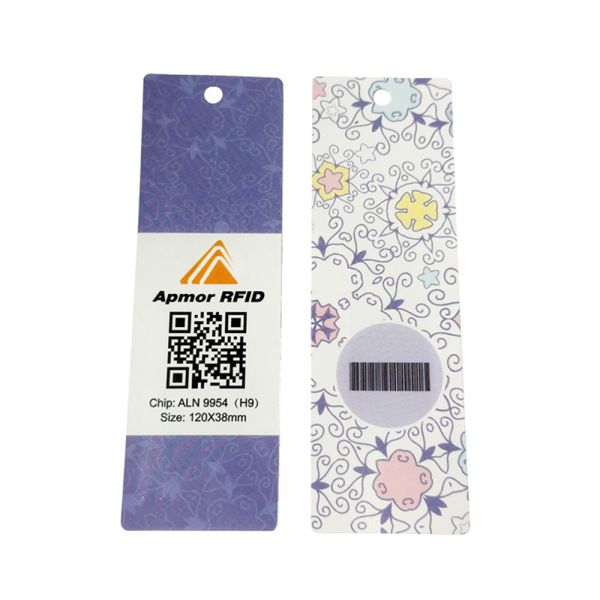
Managing inventory with printed labels alone can make tracking slower, especially when you need to identify products across warehouses, stores, libraries, or logistics operations. RFID labels for inventory give you a way to connect physical items with digital identification data, helping you scan and manage products more efficiently. For applications that require a lightweight and printable format, a paper RFID hang tag can provide both product identification and RFID functionality in one tag.
Apmor RFID Technology Co., Ltd. develops RFID tags and smart cards for different industry applications. Founded in 2022, Apmor supports customized RFID products and currently serves customers across 10 countries with a team of more than 50 people.
What Are RFID Labels for Inventory?
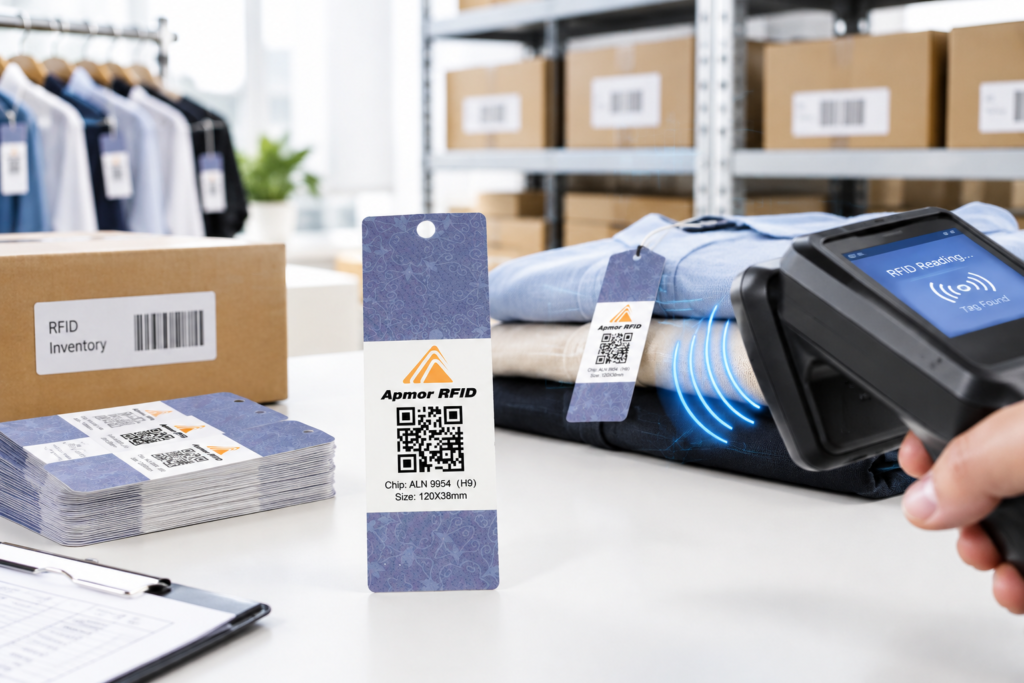
RFID labels for inventory use an RFID chip and antenna to identify an item through radio-frequency communication. Unlike a conventional barcode, an RFID system can read tag data without requiring direct visual alignment between the scanner and the printed code.
A paper RFID hang tag is particularly useful when you want to combine RFID identification with printed product information. You can customize the tag with:
- Product names and specifications
- Barcode or QR code information
- Serial numbers
- UID numbers
- Inkjet or digital printing
- Brand and product graphics
The Apmor Paper Hang Tag supports 13.56MHz HF and 860–960MHz UHF options. Depending on the selected chip, it can support ISO 14443A, ISO15693, or ISO 18000-6C protocols.
Why Use Paper RFID Hang Tags for Inventory?
When you manage clothing, books, wine, luggage, bags, trays, or logistics items, the tag format matters as much as the RFID technology itself.
Flexible Identification for Different Items
Apmor’s RFID Hang Tag uses paper, PVC, or PET materials and supports standard sizes such as 120 × 38mm, 86 × 54mm, and 50 × 50mm, while customized dimensions are also available.
This flexibility allows you to select a tag format based on the size, packaging method, and presentation requirements of your products.
HF and UHF Options
You can choose the RFID frequency according to your application:
| Feature | HF RFID Hang Tag | UHF RFID Hang Tag |
|---|---|---|
| Frequency | 13.56MHz | 860–960MHz |
| Typical use | Item identification, books, access-related applications | Inventory and logistics tracking |
| Protocol examples | ISO 14443A, ISO15693 | ISO 18000-6C |
| Reading distance | Depends on reader and environment | Depends on reader, tag and environment |
| Suitable format | Paper/PVC/PET | Paper/PVC/PET |
The listed reading distance for the Apmor product is 0.1–10m, depending on the RFID reader, tag configuration, and working environment. The tag can also operate in read-only or read-write mode depending on the selected chip type.
RFID Labels for Inventory: Real-World Applications
The product specification supports several practical inventory scenarios.
Apparel Inventory
Attach an RFID hang tag to clothing during manufacturing, warehousing, or retail operations. You can use the RFID identifier for product-level tracking while keeping size, SKU, barcode, or brand information printed on the tag.
Logistics Management
For bags, trays, packages, or other logistics assets, RFID tags can connect physical items with digital records. UHF RFID can be considered when your operation requires longer-distance identification.
Library Book Management
A paper-based RFID tag can combine printed book information with RFID identification. This can support automated identification processes while maintaining visible information for staff and users.
Wine and Product Packaging
For wine bottles and packaged goods, RFID identification can help connect individual products with inventory records. The appropriate material and tag configuration should be selected according to the product surface and operating environment.
How to Choose RFID Labels for Inventory
Before ordering custom RFID hang tags, you should define the following requirements:
- Identify the application: Determine whether you need the tag for apparel, logistics, books, wine, luggage, or another inventory category.
- Select the frequency: Choose HF at 13.56MHz or UHF at 860–960MHz according to your reader system and required reading distance.
- Choose the material and size: Select paper, PVC, or PET and confirm the required dimensions.
- Confirm chip requirements: Decide whether your system needs read-only or read-write functionality and verify protocol compatibility.
- Define printing requirements: Add barcodes, serial numbers, UID numbers, product information, or branding as needed.
- Test the tag: Evaluate reading performance with your actual RFID readers and operating environment before placing a larger order.
This process helps you avoid selecting a tag based only on price or appearance when the RFID performance must also match your inventory system.
Why Choose Apmor RFID Technology?
Apmor RFID Technology Co., Ltd. focuses on RFID labels and smart cards, with an emphasis on product customization and technical support.
The company provides:
- RFID label and smart card development
- Customized RFID product solutions
- Technical support
- Global supply chain support
- After-sales service
- HF and UHF RFID product options
Apmor was established on October 24, 2022, and reports a team of 50+ people, 95% customer satisfaction, and service coverage across 10 countries. Its Paper Hang Tag specifications also reference internationally used RFID standards, including ISO 14443A, ISO15693, and ISO 18000-6C.
FAQ
Can paper RFID labels be used for inventory tracking?
Yes. Paper RFID hang tags can be used for applications such as apparel, logistics, books, wine, bags, trays, and luggage. The suitable RFID frequency and chip should match your reader system.
What is the reading distance of an RFID hang tag?
The Apmor Paper Hang Tag lists a reading distance of 0.1–10m. Actual performance depends on the reader, tag, chip configuration, installation position, and working environment.
Can I customize RFID labels for inventory?
Yes. Apmor supports customized sizes and printing options, including offset printing, silk-screen printing, digital printing, barcodes, serial numbers, UID numbers, and inkjet printing.
Conclusion
Choosing the right rfid labels for inventory depends on more than the label material. You should consider frequency, protocol, chip type, reading distance, tag size, printing requirements, and your actual inventory environment. With HF and UHF options, multiple materials and sizes, and customizable printing, Apmor’s Paper Hang Tag provides a flexible format for apparel, logistics, library, wine, luggage, and other inventory applications.
CAT
If you are planning an RFID inventory project, contact Apmor with your item type, required reading distance, RFID reader model, tag size, material, and printing requirements. The Apmor team can help you determine a suitable RFID hang tag configuration and prepare a customized solution for testing.



Add comment