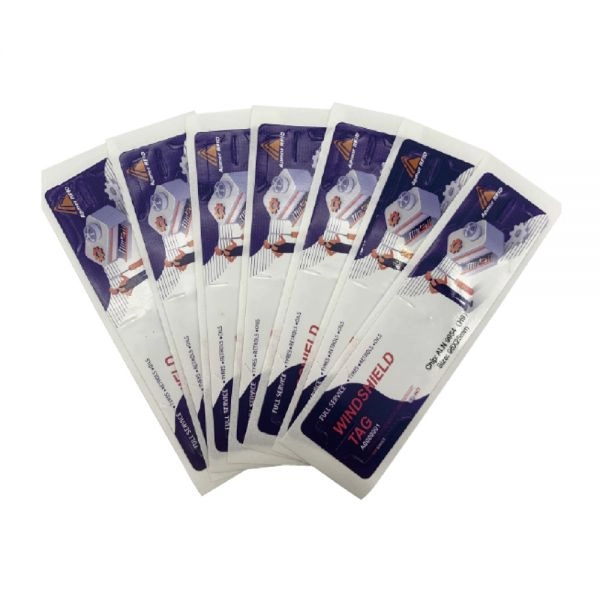
When vehicle identification depends on manual checks, you can face slow entry, inaccurate records, and limited visibility across busy sites. RFID tags and readers give you a practical way to identify vehicles, assets, and tagged items without relying on line-of-sight scanning. Apmor RFID Technology Co., Ltd. provides RFID labels and tags designed for logistics, vehicle management, product verification, and asset tracking. Its RFID Windshield Label uses UHF technology from 860–960 MHz and supports Alien H9, Monza 4, and Monza 5 chips. With paper or PVC construction, multiple size options, printing, QR codes, barcodes, and data encoding, you can adapt the label to different operational requirements.
How RFID Tags and Readers Support Vehicle Management
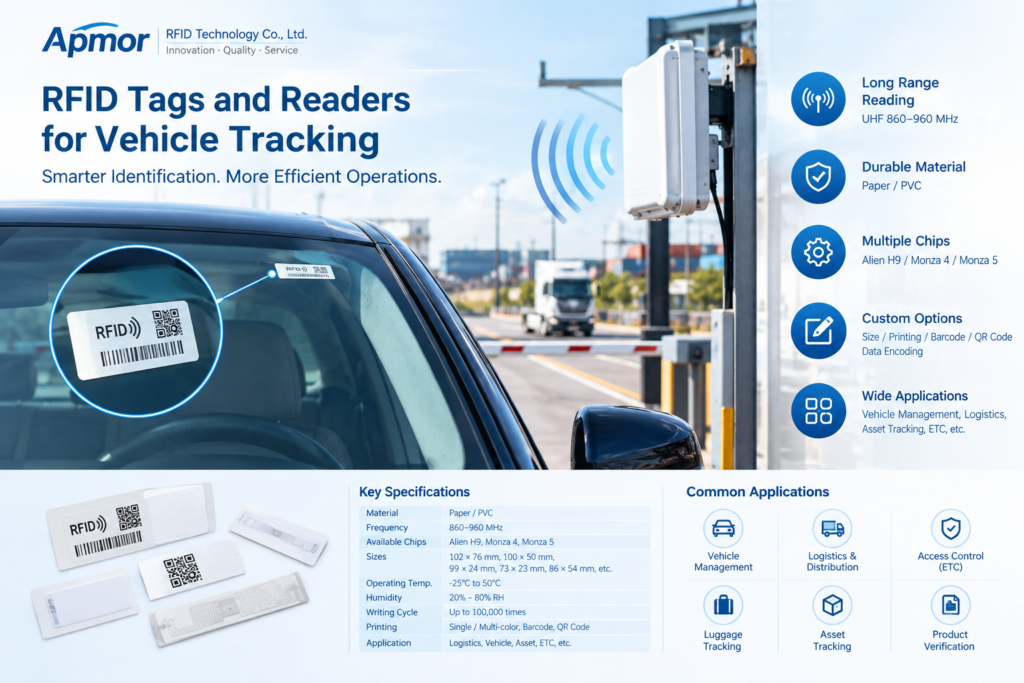
A vehicle RFID system combines a tag or label with an RFID reader and supporting software. The windshield label stores a unique identification number, while the reader captures the tag data when the vehicle enters a defined reading area.
For example, you can place an UHF RFID windshield tag on a vehicle windshield at a warehouse entrance. When the vehicle approaches, the reader identifies the tag and passes the information to your management system.
This approach can help you:
- Automate vehicle identification and entry records
- Reduce manual registration work
- Connect vehicle IDs with logistics data
- Support ETC and controlled-access applications
- Improve asset and luggage tracking
- Link physical products with digital records
Because the Apmor RFID Windshield Label operates at 860–960 MHz, it is designed for UHF RFID applications where longer-range identification is useful.
RFID Windshield Label Specifications
Choosing a suitable label starts with the physical environment, RFID chip, and data requirements. Apmor offers several configurations so you can match the label to your application.
| Specification | RFID Windshield Label |
|---|---|
| Material | Paper / PVC |
| Frequency | 860–960 MHz |
| Available Chips | Alien H9, Monza 4, Monza 5 |
| Sizes | 102 × 76 mm, 100 × 50 mm, 99 × 24 mm, 73 × 23 mm, 86 × 54 mm and others |
| Operating Temperature | -25°C to 50°C |
| Operating Humidity | 20%–80% RH |
| Writing Cycle | Up to 100,000 times |
| Printing | Single-color / multi-color |
| Additional Options | Barcode, QR code, data encoding |
| Applications | Vehicle management, logistics, asset tracking, authentication |
These specifications make the product suitable for applications that require a long range RFID tag with a compact windshield-mounted format. You can also request customized dimensions, printing, and encoding according to your deployment requirements.
How to Deploy UHF RFID Windshield Tags
You can implement an RFID vehicle identification process in several practical steps:
- Define the identification point
Determine where vehicles need to be identified, such as an entrance, loading area, parking zone, or ETC passage. - Select the RFID tag configuration
Choose the appropriate chip, label size, material, printing format, and encoding requirements. - Install the RFID reader
Position the reader and antenna according to the required reading area and site conditions. - Apply the windshield label
Attach the RFID windshield label to the designated vehicle area and maintain consistent installation positioning. - Connect identification data
Link the RFID number with your vehicle, shipment, asset, or user record in the management system. - Test the complete workflow
Check reading reliability, data accuracy, environmental conditions, and system response before full deployment.
RFID Tags and Readers vs. Barcode Identification
RFID and barcode technologies can both support identification, but they work differently. Barcode systems generally require the scanner to visually access the printed code, while RFID readers communicate with an RFID tag through radio frequency.
For vehicle management, RFID can be useful when you want automated identification without requiring drivers or operators to manually present a barcode.
A windshield RFID solution can also combine RFID, barcode, and QR code printing on one label. This gives you an additional visual identification method when required by your workflow.
Built Around Custom RFID Solutions
Apmor RFID Technology Co., Ltd. was established in 2022 and focuses on RFID labels and smart cards. The company reports a team of more than 50 people, serves customers in 10 countries, and provides customized products, technical support, global supply chain management, and after-sales service.
For this RFID Windshield Label, Apmor supports customized printing, multiple dimensions, chip selection, barcode or QR code printing, and data encoding. These options allow you to configure a custom vehicle RFID label around your identification process rather than adapting your workflow to a fixed label.
Apmor’s supplied company information does not specify an ISO or other third-party certification for this product. If your project requires certification, regulatory documentation, or application-specific compliance, you should request the relevant test reports and documentation from Apmor before purchasing.
FAQ
Can RFID windshield labels track vehicles?
Yes. An RFID windshield label can provide a unique electronic identifier that your RFID reader can associate with a vehicle record. Your software can then use that identifier for vehicle management, logistics, access control, or tracking workflows.
What frequency does this RFID windshield label use?
The product operates at 860–960 MHz, which places it in the UHF RFID range. It supports Alien H9, Monza 4, and Monza 5 chip options.
Can I customize the RFID windshield label?
Yes. Apmor supports different sizes, paper or PVC materials, single-color or multi-color printing, barcode and QR code printing, and data encoding. You can discuss your required chip, dimensions, artwork, and encoding format with the supplier before production.
Conclusion
When you need automated vehicle identification, logistics tracking, or asset management, rfid tags and readers can connect physical identification with your digital management system. Apmor’s UHF RFID Windshield Label combines 860–960 MHz operation, multiple chip options, customizable sizes, and data encoding to support vehicle and logistics applications. You can start by defining your reading environment, vehicle quantity, chip requirements, and encoding format, then ask Apmor to recommend the appropriate label configuration.
Get a Custom RFID Windshield Solution
If you are planning a vehicle tracking, ETC, logistics, or asset identification project, contact Apmor RFID Technology with your required label size, chip, quantity, printing design, and encoding data. The team can help you evaluate the RFID label configuration and provide a customized quotation for your application.


Add comment