When you need faster identification and more reliable tracking, rfid labels can help you connect physical items with digital data. However, choosing the right label requires more than selecting an RFID chip. You need to consider material, frequency, memory, read range, printing, size, and the environment where you will use the label.
Apmor RFID Technology Co., Ltd. develops RFID tags and smart card solutions for different industry applications. Its PET RFID label uses 13.56MHz HF technology, supports multiple chip options, and can combine RFID data with printed barcodes, serial numbers, and UID information. This makes the label suitable for inventory, logistics, library management, asset tracking, and electronic ticketing.
What Are RFID Labels?
RFID labels combine a physical label with an embedded RFID inlay or chip. Unlike a conventional printed label, an RFID label can store and transmit digital information to a compatible reader, allowing you to identify and manage tagged items more efficiently.
For example, you can attach an RFID inventory label to an asset and associate its unique UID with your internal database. When your staff scans the label, the system can retrieve the corresponding item information without manually entering the identification number.
Key Specifications of Apmor RFID Labels
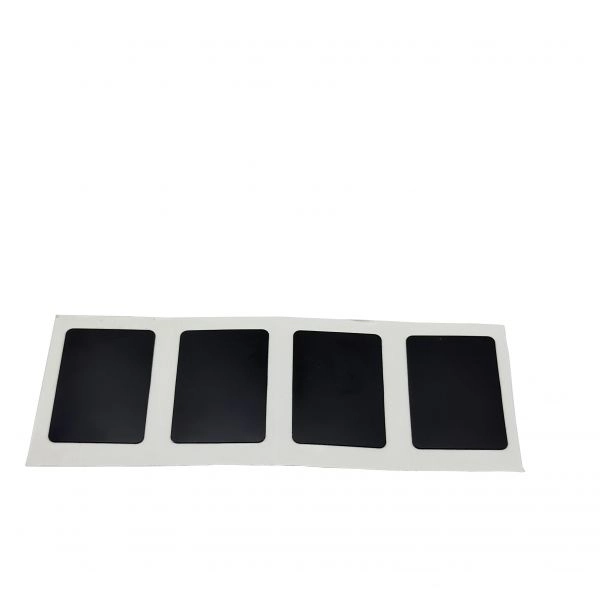
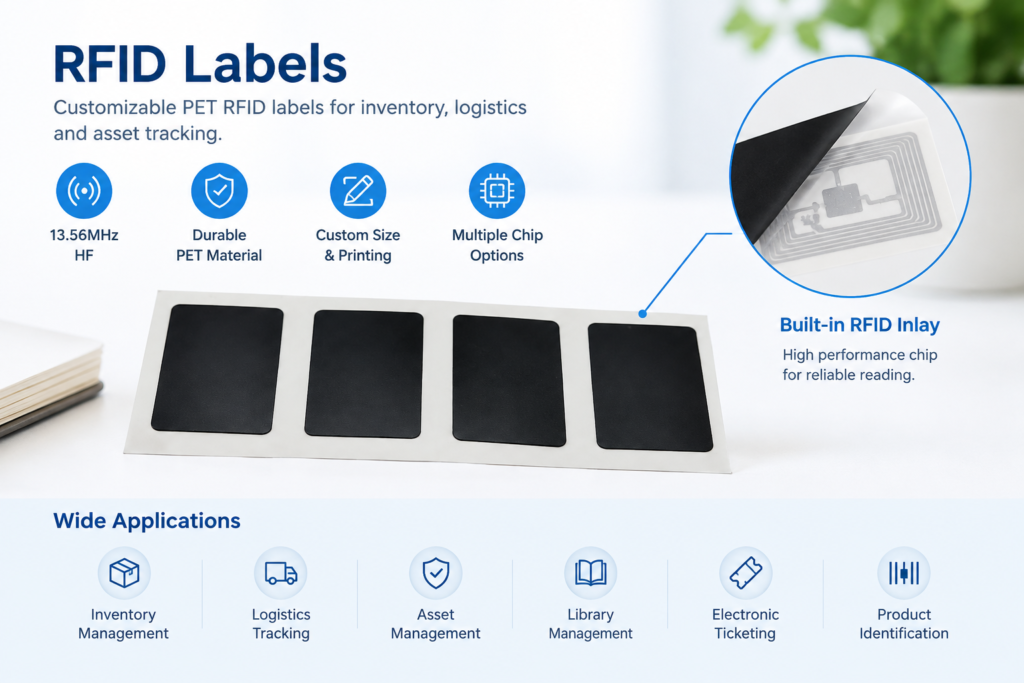
Apmor’s PET Label is designed as a customizable HF RFID solution with the following specifications:
- Material: PET
- Frequency: 13.56MHz
- Standard size: 35 × 25mm
- Size: Customizable
- Available chips: NXP S50, NXP S70, F08, I-CODE SLi series, NTAG213, NTAG215, NTAG216, and others
- Data retention: Up to 10 years
- Programming cycles: ≥100,000
- Memory: 144 bytes, 1KB, 128 bytes, and other options
- Reading range: 0–10cm, depending on the reader and antenna
- Printing options: Offset, silk-screen, digital, inkjet, barcode, serial number, and UID printing
These options allow you to select an RFID label according to your application rather than relying on a one-size-fits-all format.
Why Choose PET RFID Labels?
PET provides a practical surface for applications that require printed identification together with RFID functionality. You can customize the label dimensions, artwork, numbering, and other printed information to match your operational process.
For example, a logistics company can print a barcode and serial number on each RFID logistics label while storing additional identification data in the RFID chip. Your team can then use visual scanning or RFID reading according to the workflow.
PET RFID labels can also support applications such as:
- Inventory identification and stock management
- Fixed asset tracking
- Library book management
- Logistics and item identification
- Electronic ticketing
- Product identification
- Barcode and RFID hybrid tracking
- Customized NFC-related applications with compatible chips
RFID Labels vs. Conventional Labels
The right choice depends on the information and tracking method you need.
| Feature | RFID Labels | Conventional Printed Labels |
|---|---|---|
| Digital data storage | Yes | No |
| Wireless identification | Yes | No |
| Barcode printing | Available | Available |
| UID or serial number | Available | Printed only |
| Contactless reading | Yes | No |
| Data update capability | Depends on chip | No |
| Suitable for automated tracking | Yes | Limited |
| Custom size and printing | Yes | Yes |
If you only need visible product information, a conventional label may be sufficient. If you want to connect physical items with digital identification, an RFID label can provide an additional data layer.
How to Select Custom RFID Labels
Before ordering custom RFID labels, you should define the application and technical requirements. A clear specification helps you avoid selecting a chip or label structure that does not fit your reader or operating environment.
1. Define the application
Identify whether you need the label for inventory, logistics, asset management, library management, ticketing, or another use case.
2. Confirm the RFID frequency
Apmor’s PET Label operates at 13.56MHz HF. Confirm that your existing RFID reader and antenna support the selected frequency before production.
3. Select the chip
Choose a compatible chip according to your memory, read/write, and application requirements. Apmor supports options including NXP S50, S70, F08, I-CODE SLi, NTAG213, NTAG215, and NTAG216.
4. Set the label size and artwork
You can specify dimensions, printed graphics, barcode information, serial numbers, UID numbers, and other identification requirements.
5. Confirm testing requirements
Test the finished RFID label with your actual reader and application environment. Reading performance can vary according to the reader, antenna, installation position, and surrounding materials.
Custom RFID Labels for Business Applications
Apmor RFID Technology Co., Ltd. was established in 2022 and focuses on RFID labels and smart card solutions. The company reports a team of 50+ members, 95% customer satisfaction, and service coverage across 10 countries.
Its service model combines customized products, technical support, supply chain support, and after-sales service. This approach can help you move from a standard RFID component to a label configured for your specific workflow.
For businesses managing large numbers of items, customization can also improve identification consistency. You can combine RFID data with printed barcodes, serial numbers, or UID information on the same label, creating a practical link between physical products and digital records.
FAQ
1. What are RFID labels used for?
RFID labels are used to identify and track physical items through RFID technology. Common applications include inventory management, asset tracking, logistics, library management, and electronic ticketing.
2. What frequency does this PET RFID label use?
This PET RFID label uses 13.56MHz HF technology. Its reading range is specified at 0–10cm, although actual performance depends on the RFID reader, antenna, label position, and application environment.
3. Can I customize the size and printing?
Yes. The standard size is 35 × 25mm, while customized dimensions are available. You can also request offset printing, silk-screen printing, digital printing, barcode numbers, serial numbers, UID numbers, and inkjet printing.
Conclusion
Choosing rfid labels is not simply about adding an RFID chip to a printed sticker. You need to match the frequency, chip, memory, material, dimensions, printing method, and reader environment with your actual application. With 13.56MHz HF technology, PET construction, multiple chip options, and customizable printing and dimensions, Apmor RFID’s PET Label provides a flexible option for inventory, logistics, asset management, library, and electronic ticketing applications.
CTA
If you are planning a custom RFID label project, contact Apmor RFID Technology with your required size, application, RFID frequency, chip preference, printing artwork, and estimated quantity. The Apmor team can help you evaluate the appropriate RFID label configuration and discuss customization requirements before production.

Add comment